Showing posts with label Thoughts. Show all posts

Tuesday, May 14, 2013

Progress, Regress (a proposal)

Using real-time unemployment and labor market data to animate a kinetic sculpture.
Unemployment rates since 2008 have been and continue to be very high. But if you study a chart of unemployment data gathered by the U.S. Bureau of Labor Statistics since 1948, history shows that “business cycles” (recessions and recoveries) have occurred every 10-15 years. The most recent recession was particularly severe, and the ongoing recovery period is markedly slow and painful. But this is not the first time we’ve suffered through a recession, nor will it be the last. 

Fluctuating unemployment rates, 1948-present

While the unemployment rate has constantly fluctuated between as low as 3% and as high as 10% over the course of time, the labor market is actually much more dynamic than these numbers suggest. Hundreds of thousands of people are either losing or acquiring jobs every month, and new people are continually entering the labor force. The U.S. economy must add $150,000 jobs every month just to keep the unemployment rate stable. And the unemployment rate doesn’t include people who are disabled, involuntarily working part-time, or who have lost hope and stopped looking for a job. 

Push button toy (inspiration for the sculpture's kinetic mechanism)
My goal is to humanize these statistics by using them to animate an object we typically associate with employment and success: a ladder. The ladder will be cut it into pieces that will be drilled and threaded with steel cable, and then reconstructed to function much like a push-button toy. The tension of the cable, and the subsequent position of the ladder, will be controlled by a motorized winch. A computer will collect real-time unemployment data from the web and use a microcontroller to activate the winch. If the unemployment rate rises, the winch will unwind the cable, and the extra slack will allow the ladder to begin to slouch over. As the unemployment rates drop, the winch will wind the cable back up, and the increased tension will pull the ladder into a more erect position. The ladder will become a kind of body, the rungs like its vertebrae, and the numbers will bring it to life.

Wednesday, May 8, 2013

Restating myself

Every time I write an application - to a grant, residency, or exhibition opportunity - I write a new artist statement. I am always so happy with and proud of my new statement at the moment I complete it. I always feel like I finally expressed what my work is all about. This feeling usually coincides with re-falling in love with writing and re-identifying it as a crucial component of my art practice. But both of those feelings are unfailingly and extremely short lived. It doesn't take long to hate writing again (it's so frustrating and inflexible) or to feel embarrassed by that statement I wrote a few days or weeks ago. Nevertheless, I just finished writing a new artist statement, and I'm really proud of it, so I'm going to share it. And I hope that every time I rework my statement I get a little bit closer to hitting the nail on the head. But give me a few days and I'll probably have a different perspective. I'll eventually see that mark on the wall that's several feet from the nail that shows me how far off I was...

"I received a bachelor’s degree in design and practiced at an architectural firm in New York for several years before earning an MFA in sculpture. My artwork remains strongly rooted in design, and primarily takes the form of electronic, kinetic and interactive sculpture. Inspired by highway billboards and neon signs, my work often imitates these familiar forms of communication, co-opting strategies typically used to advertise products for the production of meaning. I think of words as found objects and I manipulate language as if it were a sculptural material, constructing words and phrases in three dimensions and then assembling and disassembling them over time.

Because my work is driven by concept as opposed to process, my practice is collaborative and interdisciplinary, and I often explore the same idea in many mediums, including drawing, photography, video and installation. My work’s most common recurring theme is an exploration of the aesthetics of time. I believe that art can and should be affected by time, as opposed to frozen in it. Like everything else in the world – our bodies, the seasons, machines – my work often moves, changes, deteriorates, and in some cases, dies."

Thursday, May 2, 2013

Present Perfect

I want to make a series of sculptures based on works of art that other people tell me about having seen, but that I've never seen myself. This one is based on a piece Mike Fleming saw in the MoMA a few years ago. He said a marble-sized metal sphere was placed on a keyboard's letter G so that the computer was continuously typing GGGGG... and that you could see it had been typing G for a long time based on the page # displayed in Microsoft Word. He can't remember the name of the original artist.

So, I placed a large rock on my old laptop's keyboard so that it types the letter Y continuously and infinitely.

YYYYYYYYYYYYYYYYYYYYYYYYYYYYYYYYYYYYYYYYYYYYYYYYYYYYYYYYYYYYYYYYYYYYYYYYYYYYYYYYYYYYYYYYYYYYYYYYYYYYYYYYYYYYYYYYYYYYYYYYYYYYYYYYYYYYYYYYYY

I think that if I ever show this in an exhibition I will use a rock that I find in that local area. When the exhibition is over, I will print out the document (however many pages, depending on the length of the show) and then display the stacked pages with the rock on top, as an artifact. Each exhibition at all the different locations will then produce its own unique artifact.


Friday, June 22, 2012

A new, and hopefully improved, artist statement

I am an interdisciplinary artist whose work commonly takes the form of kinetic, interactive, and time-based sculpture. I often use language and time as sculptural materials. The inventor Charles Babbage once said, “Machines have been taught arithmetic instead of poetry.” In a way, I teach machines poetry. I also teach them to stop making sense.

Like found objects, written language appeals to my desire to provide my audience with a very basic level of accessibility. Any literate person can hardly avoid reading, and thus understanding, any text placed before them. The words and phrases that intrigue me most are found in our everyday vocabulary, simple words that have many definitions and thereby allow for multiple layers of meaning. If such a word or phrase is constructed in three dimensions, it can be broken down into its most fundamental parts, and assembled and disassembled over time or as a result of viewer interaction. Words can appear and disappear, allowing the work’s meaning to remain in flux and illustrating how language is constantly being reshaped by our interactions.

“Eternity” (2010) is a wall-mounted sculpture that was made in collaboration with Mike Fleming. It consists of 30 electric clocks rear-mounted to a large sheet of white acrylic whose hands collectively spell the word ETERNITY once every twelve hours. Like most of my work, “Eternity” investigates the close relationship between language, image and time. The incessant birth, death and rebirth of that word is a metaphor for the fleeting nature of our own existence, and for our desire to live forever. Time, by definition, is “the indefinite continued progress of existence, and events in the past, present and future regarded as a whole.” As we mark, measure and keep time, so too should we contemplate and evaluate the ways we spend it. Time is the ultimate currency.

Making art is like speaking in tongues. I am compelled to speak without knowing exactly what I’m saying. My work requires an interpreter – someone willing to step forward (sometimes literally), to investigate, to decipher, and to translate the work’s message. Because my art practice is driven by concept as opposed to process, my most successful work is made in collaboration. Ideas are always better when they’re bounced around a bit. Many artists enjoy working alone in their studios, but I prefer making work in conversation. It allows me to share the experience, the excitement, the responsibility and the success with another person. The final product is essentially also a collaboration, this time between the artists and the audience. In the end, the work is yours as much as it is mine.

Friday, January 6, 2012

Tuesday, May 3, 2011

What it means to Wonder.

I am beginning to notice (and accept) that writing and reflection are very important parts of my artistic practice. So I'm trying to embrace it. This is my abstract for a paper I would like to write for a session at next year's College Art Association conference in LA, titled "Chewing on Words: Reconsidering Text in its Materiality":

The “most-remembered” commercial that aired during the 2010 Super Bowl didn’t flaunt sexy women in bikinis or use computer-generated imagery or effects. In fact, it used hardly any imagery whatsoever. It simply showed text being entered into a Google search bar. The words and phrases appeared on the screen as though a person were typing them in – “study abroad paris”, “impress a French girl”, “long distance relationship advice”, and finally “how to assemble a crib” – and suggested a narrative that viewers were asked to construct word by word in just 52 seconds. This critically acclaimed ad cost Google more to air than it did to produce, but its astounding popularity and effectiveness are telling indicators of the power of text as a visual medium.


In this paper, I will explore how the use of text in time-based and interactive sculpture can give viewers the authority to construct a work’s meaning both individually and collectively, using my own artwork as primary examples. My work asks viewers to wonder about questions such as “what is the length of now?” and “what is the size of here?”. I utilize words that have more than one meaning (such as ‘now’ or ‘then’), or words whose meaning is so abstract that their definition amounts to almost nothing (such as ‘eternity’ or ‘wonder’). I invite viewers to construct their own understanding of those words through time-based objects and/or physical interaction.

Works such as The Length of Now (2008) and Eternity (2010) will be placed in an art historical context by comparison to Joesph Kosuth’s One and Three Chairs (1965). Kosuth’s work will be used to illustrate Conceptual Art’s longstanding interest in the close relationship between language and image. It will also be used to demonstrate how a verbal description of ‘chair’ offers a viewer more room for interpretation than the image, which is very specific and leaves little to the imagination.

(Pictured above: The Length of Now, 2008)

(Pictured above: Eternity, 2010)

(Pictured above: Joseph Kosuth's One and Three Chairs, 1965)

Similarly, On Kawara’s “Date Paintings” (the Today series) will be used to exemplify how the meaning of text is largely determined by time and place (less specifically referred to as context). A work’s meaning during the time and place of ‘fabrication’ (which is another word that has a wonderful dual meaning) can be very different from a viewer’s experience and understanding of it at the time and place of its exhibition. Between Now and Then (2008) demonstrates how the meaning of such words is determined by a viewer’s position in space – ‘then’ can refer to both the past and the future.

(Pictured above: On Kawara's 19 February 2006, from Today series, 2006)

(Pictured above: Between Now and Then, 2008)

My interactive sculptures, The Ecstasy of Influence (2010) and Wonder (2011), will be used to illustrate the concept of intersubjective encounters as posed by Nicholas Bourriaud in Relational Aesthetics. Both of those works require the participation of more than one person in order for meaning to be constructed. One must be the ‘maker’ (or performer) and the other must play the role of the ‘viewer’. Because of this, meaning is elaborated collectively as opposed to individually.

(Pictured above: The Ecstasy of Influence, 2010)

(Pictured above: Wonder, 2011)

Thursday, April 28, 2011

Where wonder came from.

(This is the original drawing I made of Wonder in my sketchbook)

(This is the sculpture in progress in my studio - the white dots are made of computer paper I cut out and taped on so I could move them around and decide how the word should look)

Kinetic art is a very new field for me, and I have actually found the medium to be at once exhilarating and frustrating. Like anything that moves, such as your car, its fabrication requires a lot of precision. I received an immense amount of help with its assembly from a man named Robert Stevens, a colleague of mine at Bowdoin College. Bob is a supremely humble and helpful machinist, and he assisted me with the project's planning and problem solving when I first approached him with my idea. After I had mapped out the coordinates for each motor's location on the 48"x48" panel, Bob used a CNC router to drill mounting holes in those exact positions. He also fabricated many small plastic parts, such as the black arms that are attached to each of the 54 motors. Without Bob's help, I would never have been able to make this sculpture function. Many artists make work alone in their studios. Other artists, like me, sometimes require teams of people with different skill sets to help make their dreams a reality.

(This is how I figured out where the motors needed to be mounted - the different colored construction paper represents the different lengths of the motor shafts)

(This is Robert Stevens showing me how the coordinates I gave him were programmed into the CNC router)

(This is what the back of the board looks like now - a tangle of wires)

In addition to precise fabrication, kinetic art also needs constant maintenance and repair. Since installing this sculpture at the Portland Museum of Art, I have had to replace eight different motors that have broken for one reason or another. It is running so many hours per day, responding with movement to each and every person that walks by. Because of that, I check on the work at least once a week to make sure it is functioning properly. But I often wonder (no pun intended) about its lifespan. I definitely think of it as being alive. But the question is for how long?

(This is me repairing one of those broken motors during the installation)

Tuesday, April 26, 2011

How to discover your life purpose in about 20 minutes.


"Here’s what to do:
  1. Take out a blank sheet of paper or open up a word processor where you can type (I prefer the latter because it’s faster).
  2. Write at the top, “What is my true purpose in life?”
  3. Write an answer (any answer) that pops into your head. It doesn’t have to be a complete sentence. A short phrase is fine.
  4. Repeat step 3 until you write the answer that makes you cry. This is your purpose."
(I did not make this up. I found it here. I think it's so ridiculous it's kind of amazing.)

Monday, April 25, 2011

Setting sculpture in motion.

I just found this video that someone took of my sculpture and posted on youtube. The woman gets so close to making the white dots spell 'wonder', but not close enough (literally). It's great to see that people are able to have fun with it either way. I also think this video demonstrates how this work requires the viewer to become a kind of performer. One person has to approach the work while another watches them activate it from afar ('wonder' is seen best from a distance... from up close it's like a pointillist painting). Looking is no longer passive, it is active. It is performative. Slight body movements towards or away from the work cause it to change. It asks you to dance! And it allows others to watch you dance!


And here is another video that shows Wonder in motion very close up. It's a 10 second commercial that the Portland Museum of Art made for TV to advertise the show. Now you can see what the experience would be like from that woman's perspective.


I will be making my own videos of the work later this week, and hopefully writing more about the performance of viewing, so stay tuned...

Saturday, February 12, 2011

Sunday, February 6, 2011

A new idea.

Imagine a jump rope that is circling endlessly in a dimly lit, otherwise empty room. It would use a mechanism similar to this one (so it can move on its own, without a person on each end):


and it would be made of a glowing white neon LED light rope like this:

And to top it all off, it would be running off of a motor that makes it spin at one rotation per second, so the rhythm made by the rope hitting the floor would mimic the ticking of a clock's second hand.

(Is imagining it enough, or should I go through the trouble of making it a reality?)

Saturday, January 8, 2011

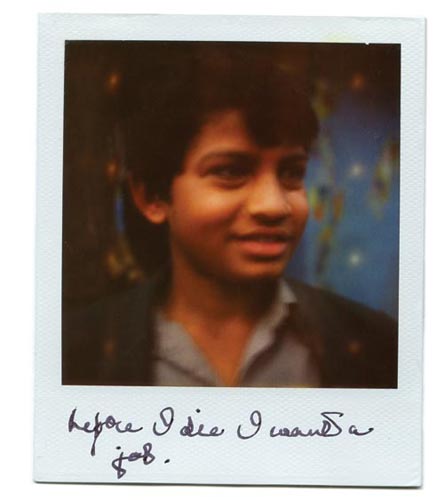
Before I die I want to...

Apropos of New Years resolutions... I recently stumbled upon a website that posts polaroids of people saying what they want to do before they die. It's amazing how many people say they want to write a book, travel, go to outer space, go skydiving, own a dog, be in love, or have babies. After looking through hundreds of these photos I realized I was getting frustrated by the fact that I wasn't coming across many statements that were unique or profound. I was actually surprised at how many of the things people stated are things that I have already done. But I guess that, when it comes down to it, no answer to this question could ever be that profound. There are certain limits to what a person can accomplish in life. And in the great scheme of things, publishing a book or having babies isn't really that remarkable. Everything that needs to be done has already been done.


Friday, December 10, 2010

Words that try to make sense of what I do.

In addition to writing an artist statement for a catalogue that's going to be published for the 2011 Biennial at the Portland Museum of Art, I also had to answer the following questions:

Notes on process: How would you describe your artistic process? Feel free to discuss any aspect of the making of the work from concept to finish, choice of media and materials, etc.

Notes on content: What is your intent with the work, your hopes for the viewer’s encounter, the meaning or purpose for creating this work? What are your inspirations and influences?

And here is what I wrote:

Before you read this, you should know that I've probably already changed my mind. Changing my mind is one of my favorite things to do.

My work always begins with an idea. Where those ideas come from is up for debate. Do they come from within me, like magical beads of mental perspiration? Or are they actually just reflections of things that already exist in the world around me? I’m unsure. But my artistic process involves much more reading, observing, and plain old life-living than actual making. I notice, I wonder, I reflect, I plan, and then eventually I execute.

My ideas are often inspired by specific objects I encounter in my everyday life – clocks, Post-it notes, belly button lint, disposable coffee cups, colorful pennant flags, those wacky-arm-waving-inflatables you see dancing in the wind at used car dealerships… By employing devices and processes that are ordinary and familiar, I hope to encourage a certain level of understanding and participation.

My artwork primarily takes the form of sculpture, installation and interactive media. It often investigates time and change - the subtle, everyday evidence of time’s passing. Is time cyclical or linear, finite or infinite? How do we identify change? How do we quantify it? To me, time represents an accumulation of moments, an accumulation of ‘now’s. What is the length of now? What is its weight? What does it mean to be ‘here’? There is a subtle distinction between absence and presence. Now and then are one and the same. Our days are numbered by our daily rituals.

I make work that requires further investigation. I attempt to materialize the intangible. I hope to show that we can still find wonder in the world around us.

Thursday, September 23, 2010

p.s.

I love living in small towns where all the stoplights start flashing after midnight.

Friday, September 17, 2010

"Go up the hill and down the hill and you are there."

I am about to leave for a long weekend in the woods on Saranac Lake, and these are the last bits of the directions I was given. So perfect. I'll see you in a few days, civilization...

Thursday, September 16, 2010

pictures of words


Top image is mine. Sad Note is by Bas Jan Ader (found here).

I like the idea of writing notes, and instead of sending them, taking pictures of them...

Monday, September 13, 2010

To Live in the Space of a Moment, and To Understand Eternity.

This is the title of a lecture I am going to give to faculty at Bowdoin about my work on October 20th.
(it's another quote from the book The Tracker, which is blowing my mind...)

Saturday, September 11, 2010

thank heavens

I don't really believe in astrology, so to speak. And I guess by believe in, I mean rely on. But I like to read my horoscope sometimes, usually when I'm looking for confirmation about something that I already know in my gut. And that's the case with this week's horoscope from Free Will Astrology, for sure:

"Last May, riots in Santa Cruz, California trashed 18 buildings in the downtown area. But for one store owner, the mayhem brought unexpected blessings. She was able to tap into a city fund that not only paid for her broken front window, but also allowed her to make several improvements, like adding fresh paint, a new awning, and better lighting. "I never would have thought when I got that call at 1 in the morning that this was going to turn into such a wonderful thing for us," Diane Towns told the Santa Cruz Sentinel. I predict a similar progression for you, Aquarius. An event that seemed like bad luck at the time will ultimately lead to good luck."

Thank you, universe!

Friday, July 23, 2010

I appreciate wavering lines but I do not make them

"I like things that are handmade and I like to see people's hand in the world, anywhere in the world; it doesn't matter to me where it is. And in my own work, I do everything by hand. I don't project or use anything mechanical, because even though I do spend a lot of time trying to perfect my line work and my hand, my hand will always be imperfect because it's human. And I think it's the part that's off that's interesting, that even if I'm doing really big letters and I spend a lot of time going over the line and over the line and trying to make it straight, I'll never be able to make it straight. From a distance it might look straight, but when you get close up, you can always see the line waver. And I think that's where the beauty is." -Margaret Kilgallen

Lately I've been trying to figure out why I like to hire people to make things for my artwork instead of doing it myself (for instance, my inflatable self-portrait was made by an advertising company). It's not that I think I'm incapable. It's almost like it's more fun to let other people make some of the decisions. The outcome is more of a surprise that way. And also, I think I'm too much of a perfectionist. I'd never allow my own lines to waver, but I always appreciate the way other peoples' do. So perhaps by giving some control away I allow those beautiful imperfections to occur that would otherwise be erased by my anal retentive instincts. 

I think I also like the idea of hiring people because it gets more people involved in the project. It feels lees like a selfish, solo enterprise, and more like a community undertaking. The people who do work for me are forced to care about the work, at least to a degree, not only because they're paid to but because they contributed some of their creativity to it. So, if the final work of art is like an umbrella (metaphorically speaking), the more people that are involved in its making, the bigger the umbrella grows, and the more people can huddle together under it when it rains.

Thursday, July 15, 2010

Imagine Eternity in Times Square

Imagine eternity in Times Square. Eternity, by definition, is “a state to which time has no application.” Eternity is timelessness.

Eternity is a wall-mounted kinetic sculpture that employs 30 electric clock movements and 36 hour and minute hands. Once every twelve hours the hands align to spell the word ETERNITY, which in this case only lasts a mere split second (video documentation available at vimeo.com/aliciaeggert).

We propose to bring Eternity to Times Square in one of many possible forms. The ideal realization would be to fabricate it at a much larger scale and erect it on an existing billboard. High-torque motors would be rear-mounted to the billboard’s structure and large, black, custom-made clock hands would rotate above the blank white surface of its front. The hands would be designed to align exactly at noon and at midnight every day, creating two events that would attract an audience eager to witness a fleeting moment of timelessness in Times Square. A potential addition to the work would be an LED countdown clock indicating the time “until eternity,” reminiscent of the countdown that occurs every New Year’s eve.

An active digital component of the piece would be a website featuring a live video feed, making it accessible to Internet audiences. Time-lapse photography would also be taken for the duration of the exhibition, resulting in a dynamic stop-motion animation of the work in relation to the flow of traffic in Times Square.

Other possible installation sites include vacant storefront windows, building facades, and the lobbies of office buildings, theaters and hotels, where the scale of the available location would determine the sculpture’s size and construction methods. The universal nature of time and its relevance to commerce, communication and culture ensures that any location in Times Square would be an appropriate site for Eternity – an ever-changing piece for an ever-changing place.

Imagine Eternity in Times Square.

Sincerely,
Alicia Eggert & Mike Fleming

(from our letter of application to the Times Square Alliance)