Friday, May 13, 2011


The more I look at things, I cannot get rid of the feeling that existence is quite weird.


Wednesday, May 4, 2011

In pursuit of something elusive.

"I think a great deal about what it means to be an artist.
I reflect on the elaborate psychological mechanisms required to pursue something so elusive, so ambiguous. I often wonder: ‘Am I talking to myself?’
I don’t make work for other people, but as an artist, I need to be in dialogue with the world that exists beyond my overpopulated cranium. I’ve concluded that to be effective-to be functional-I must guzzle an eye-popping cocktail of delusion and narcissism.
It occurred to me that being an artist is a great deal like being a dictator.
Just like a dictator, I must live in a closed loop of self-delusion. A place where my words and ideas always ring true. A gilded daydream of grandiosity. There can be no room for doubt. I must be convinced that I have something vital to say. I must believe that the world is waiting in keen anticipation to hear my message."
(This text is copied from the artist statement of Phillip Toledano, who also made that photograph of his daughter - read more about it here. Thanks, Genevieve!)
Tuesday, May 3, 2011
What it means to Wonder.
I am beginning to notice (and accept) that writing and reflection are very important parts of my artistic practice. So I'm trying to embrace it. This is my abstract for a paper I would like to write for a session at next year's College Art Association conference in LA, titled "Chewing on Words: Reconsidering Text in its Materiality":
The “most-remembered” commercial that aired during the 2010 Super Bowl didn’t flaunt sexy women in bikinis or use computer-generated imagery or effects. In fact, it used hardly any imagery whatsoever. It simply showed text being entered into a Google search bar. The words and phrases appeared on the screen as though a person were typing them in – “study abroad paris”, “impress a French girl”, “long distance relationship advice”, and finally “how to assemble a crib” – and suggested a narrative that viewers were asked to construct word by word in just 52 seconds. This critically acclaimed ad cost Google more to air than it did to produce, but its astounding popularity and effectiveness are telling indicators of the power of text as a visual medium.
In this paper, I will explore how the use of text in time-based and interactive sculpture can give viewers the authority to construct a work’s meaning both individually and collectively, using my own artwork as primary examples. My work asks viewers to wonder about questions such as “what is the length of now?” and “what is the size of here?”. I utilize words that have more than one meaning (such as ‘now’ or ‘then’), or words whose meaning is so abstract that their definition amounts to almost nothing (such as ‘eternity’ or ‘wonder’). I invite viewers to construct their own understanding of those words through time-based objects and/or physical interaction.
Works such as The Length of Now (2008) and Eternity (2010) will be placed in an art historical context by comparison to Joesph Kosuth’s One and Three Chairs (1965). Kosuth’s work will be used to illustrate Conceptual Art’s longstanding interest in the close relationship between language and image. It will also be used to demonstrate how a verbal description of ‘chair’ offers a viewer more room for interpretation than the image, which is very specific and leaves little to the imagination.

 (Pictured above: The Length of Now, 2008)

 (Pictured above: Eternity, 2010)
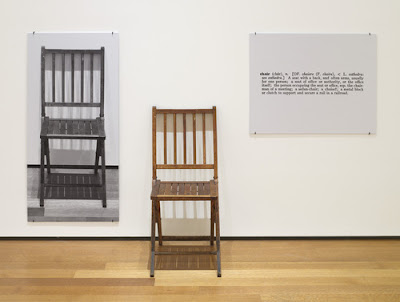 (Pictured above: Joseph Kosuth's One and Three Chairs, 1965)
The “most-remembered” commercial that aired during the 2010 Super Bowl didn’t flaunt sexy women in bikinis or use computer-generated imagery or effects. In fact, it used hardly any imagery whatsoever. It simply showed text being entered into a Google search bar. The words and phrases appeared on the screen as though a person were typing them in – “study abroad paris”, “impress a French girl”, “long distance relationship advice”, and finally “how to assemble a crib” – and suggested a narrative that viewers were asked to construct word by word in just 52 seconds. This critically acclaimed ad cost Google more to air than it did to produce, but its astounding popularity and effectiveness are telling indicators of the power of text as a visual medium.
In this paper, I will explore how the use of text in time-based and interactive sculpture can give viewers the authority to construct a work’s meaning both individually and collectively, using my own artwork as primary examples. My work asks viewers to wonder about questions such as “what is the length of now?” and “what is the size of here?”. I utilize words that have more than one meaning (such as ‘now’ or ‘then’), or words whose meaning is so abstract that their definition amounts to almost nothing (such as ‘eternity’ or ‘wonder’). I invite viewers to construct their own understanding of those words through time-based objects and/or physical interaction.
Works such as The Length of Now (2008) and Eternity (2010) will be placed in an art historical context by comparison to Joesph Kosuth’s One and Three Chairs (1965). Kosuth’s work will be used to illustrate Conceptual Art’s longstanding interest in the close relationship between language and image. It will also be used to demonstrate how a verbal description of ‘chair’ offers a viewer more room for interpretation than the image, which is very specific and leaves little to the imagination.


Similarly, On Kawara’s “Date Paintings” (the Today series) will be used to exemplify how the meaning of text is largely determined by time and place (less specifically referred to as context). A work’s meaning during the time and place of ‘fabrication’ (which is another word that has a wonderful dual meaning) can be very different from a viewer’s experience and understanding of it at the time and place of its exhibition. Between Now and Then (2008) demonstrates how the meaning of such words is determined by a viewer’s position in space – ‘then’ can refer to both the past and the future.
 (Pictured above: On Kawara's 19 February 2006, from Today series, 2006)

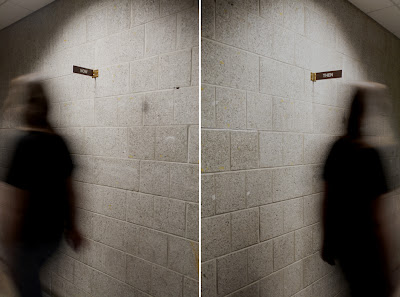 (Pictured above: Between Now and Then, 2008)
My interactive sculptures, The Ecstasy of Influence (2010) and Wonder (2011), will be used to illustrate the concept of intersubjective encounters as posed by Nicholas Bourriaud in Relational Aesthetics. Both of those works require the participation of more than one person in order for meaning to be constructed. One must be the ‘maker’ (or performer) and the other must play the role of the ‘viewer’. Because of this, meaning is elaborated collectively as opposed to individually.

 (Pictured above: The Ecstasy of Influence, 2010)

 (Pictured above: Wonder, 2011)


My interactive sculptures, The Ecstasy of Influence (2010) and Wonder (2011), will be used to illustrate the concept of intersubjective encounters as posed by Nicholas Bourriaud in Relational Aesthetics. Both of those works require the participation of more than one person in order for meaning to be constructed. One must be the ‘maker’ (or performer) and the other must play the role of the ‘viewer’. Because of this, meaning is elaborated collectively as opposed to individually.


Sunday, May 1, 2011
People are Wondering.
Footage of people interacting with Wonder at the Portland Museum of Art. (I love the dancing that happens towards the end!)
Friday, April 29, 2011
When's the last time you took one of these?

(I just found this on facebook and I think it's brilliant. There are some ideas I really wish I had had myself.)
Thursday, April 28, 2011
Where wonder came from.


Kinetic art is a very new field for me, and I have actually found the medium to be at once exhilarating and frustrating. Like anything that moves, such as your car, its fabrication requires a lot of precision. I received an immense amount of help with its assembly from a man named Robert Stevens, a colleague of mine at Bowdoin College. Bob is a supremely humble and helpful machinist, and he assisted me with the project's planning and problem solving when I first approached him with my idea. After I had mapped out the coordinates for each motor's location on the 48"x48" panel, Bob used a CNC router to drill mounting holes in those exact positions. He also fabricated many small plastic parts, such as the black arms that are attached to each of the 54 motors. Without Bob's help, I would never have been able to make this sculpture function. Many artists make work alone in their studios. Other artists, like me, sometimes require teams of people with different skill sets to help make their dreams a reality.


In addition to precise fabrication, kinetic art also needs constant maintenance and repair. Since installing this sculpture at the Portland Museum of Art, I have had to replace eight different motors that have broken for one reason or another. It is running so many hours per day, responding with movement to each and every person that walks by. Because of that, I check on the work at least once a week to make sure it is functioning properly. But I often wonder (no pun intended) about its lifespan. I definitely think of it as being alive. But the question is for how long?

Tuesday, April 26, 2011
How to discover your life purpose in about 20 minutes.
"Here’s what to do:
- Take out a blank sheet of paper or open up a word processor where you can type (I prefer the latter because it’s faster).
- Write at the top, “What is my true purpose in life?”
- Write an answer (any answer) that pops into your head. It doesn’t have to be a complete sentence. A short phrase is fine.
- Repeat step 3 until you write the answer that makes you cry. This is your purpose."
(I did not make this up. I found it here. I think it's so ridiculous it's kind of amazing.)
Monday, April 25, 2011
Setting sculpture in motion.
I just found this video that someone took of my sculpture and posted on youtube. The woman gets so close to making the white dots spell 'wonder', but not close enough (literally). It's great to see that people are able to have fun with it either way. I also think this video demonstrates how this work requires the viewer to become a kind of performer. One person has to approach the work while another watches them activate it from afar ('wonder' is seen best from a distance... from up close it's like a pointillist painting). Looking is no longer passive, it is active. It is performative. Slight body movements towards or away from the work cause it to change. It asks you to dance! And it allows others to watch you dance!
And here is another video that shows Wonder in motion very close up. It's a 10 second commercial that the Portland Museum of Art made for TV to advertise the show. Now you can see what the experience would be like from that woman's perspective.
I will be making my own videos of the work later this week, and hopefully writing more about the performance of viewing, so stay tuned...


How is a work of art altered by our looking at it?
An excerpt from "Art Current: The Portland Museum of Art Biennial" by Brita Konau, published by The Free Press:
"Eggert's interactive piece I at first thought just artfully cute. On a black panel, small levers are set in motion, through proximity sensors, to spell out the title of the piece, "Wonder." Upon further reflection though, I came to appreciate the questions this work asks. How is a work of art altered by our looking at it? How are we changed? Is physical observation replaceable by perusal of reproductions? Can that still instill the same reaction, the same "wonder"? Questions that have not gone away since Walter Benjamin reflected on "The Work of Art in the Age of Mechanical Reproduction." For me the showstoppers are not the large, site-sensitive installations. Rather, they are the quiet, sophisticated works that ask you to look closely and spend contemplative time with them."
Thursday, April 21, 2011
My first podcast!
Wednesday, April 20, 2011
Tuesday, April 19, 2011


Sunday, April 17, 2011
Tourists (For Mike), 2011
Made in collaboration with Layla Marcelle Mrozowski, Jamie Carestio and Jacob Raeder.
Thursday, April 14, 2011
Review of the PMA Biennial

"I'm applauding Alicia Eggert's kinetic sculpture "Wonder." The hum of electricity and whirling mechanisms really work for me against Wing-Sproul's wash of sound. The piece has an enigmatic quality that, combined with an engaging interactive element, careful execution, and good design, makes for an exciting finale to the show."
Read the entire article here.
Wednesday, April 13, 2011

Subscribe to:
Posts (Atom)